Since the 1970s hardware performance has scaled roughly linearly. But to continue that growth past single-core scaling the Industry turned to multiprocessing. Multicore, manycore, single-instruction multiple-data (SIMD), and GPUs have largely driven performance increases for the last 20 years.
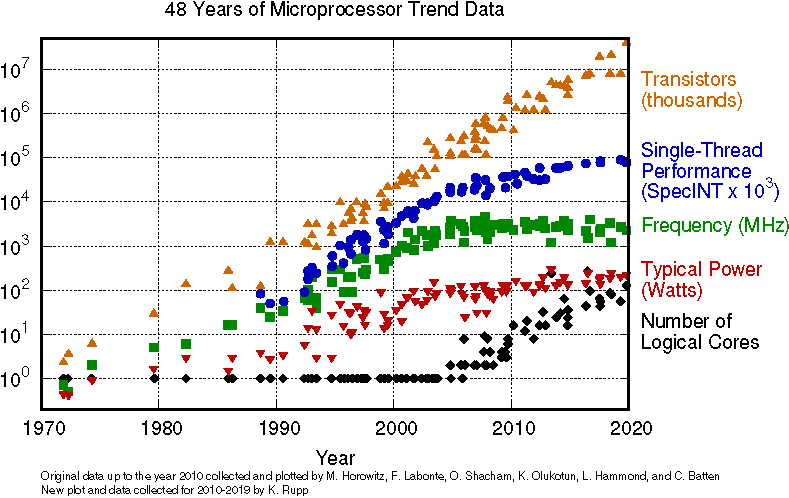
As it turns out though, our human meat brains are really not made for parallelism and so software has largely failed to capture most of these recent performance gains.
And this trend shows no signs of slowing down: Hardware is expected to become more parallel and specialized. With manycore architectures migration from supercomputers to everyday hardware and embedded coprocessors in devices like hard-drives and cameras.
Additionally, cybersecurity will play an increasingly important role, particularly in light of recent global developments, as computers intertwine themselves even more with the fabric of our society.
k23 is an experimental operating system that asks the question "What would an OS designed for this future look like?". WebAssembly allows developers to write once and run everywhere, even on the most heterogeneous system with the peace of mind that strict sandboxing contains and limits potential malware. Additionally WASM allows the kernel to optimize much more aggressively and tightly pack running programs. Its threading system is designed to be lightweight and allow for massive concurrency.